
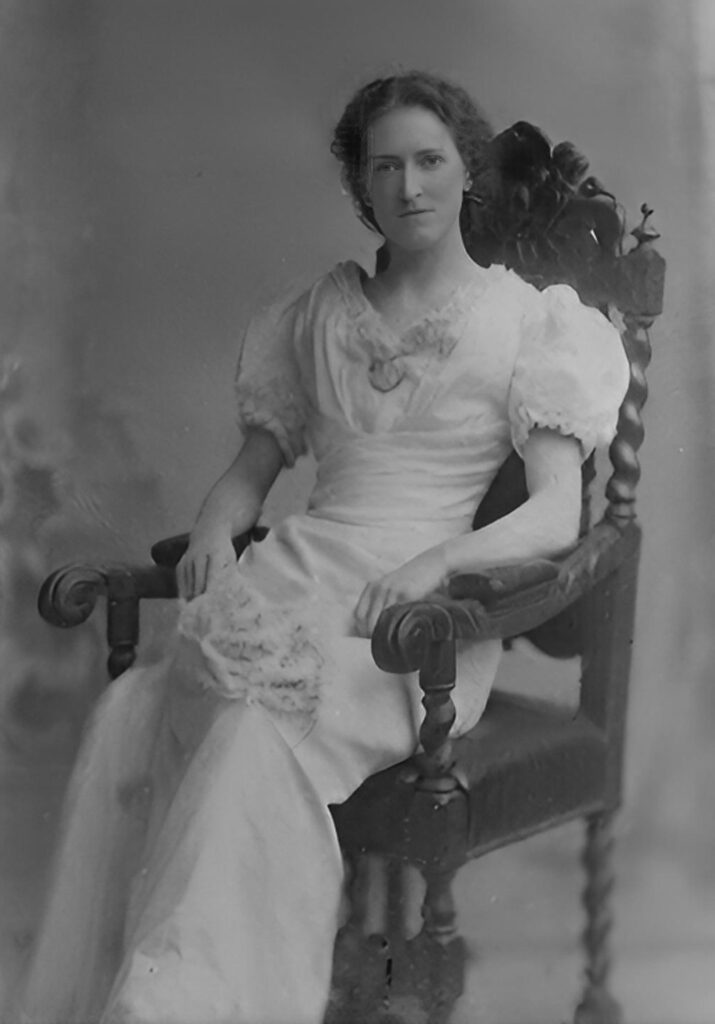
Marjory Wardrop (1869–1909)
Marjory Scott Wardrop was a British scholar, linguist, and translator whose pioneering work opened the door to Georgian literature and culture for English-speaking audiences. She was born in 1869 in Oxford, England to a upper middle class family. From an early age, Marjory displayed a remarkable aptitude for languages, studying Latin, Greek, Russian, and several modern European tongues.
Both Marjory and her brother, Sir Oliver Wardrop, developed a fascination with the Caucasus after reading Greek myths such as the tale of Jason and the Golden Fleece, which located the fabled land of Colchis in what is now western Georgia. While Oliver was able to pursue this curiosity through travel and diplomatic work, Marjory, as a woman in late Victorian Britain, was expected to remain at home. Her intellectual engagement with the region, however, only deepened through study, correspondence, and independent research.
In 1894, determined to see the country that had long captured her imagination, Marjory Wardrop traveled to Georgia with her mother, following an invitation from the eminent Georgian writer Ilia Chavchavadze, who had read her English translation of one of his short stories. The journey was a bold and unconventional undertaking for women of their time. During her stay, Marjory immersed herself in the Georgian language, met leading writers and intellectuals, and collected stories and folklore from across the region. These encounters laid the foundation for her later translations, which introduced Georgian literature to the English-speaking world for the first time.
Among her most notable works are her translations of The Life of Saint Nino and Shota Rustaveli’s The Knight in the Panther’s Skin (Vepkhistqaosani). Her approach to translation combined scholarly precision with literary sensitivity, reflecting her profound respect for Georgian culture and her commitment to rendering it faithfully and beautifully in English.
Beyond her linguistic achievements, Wardrop’s work carried a subtle feminist dimension: she challenged the limits placed on women’s intellectual and cultural participation at the turn of the twentieth century. Through her travels and translations, she asserted the authority of a woman scholar engaging with a foreign culture on her own terms.
Marjory Wardrop died suddenly from a stroke in 1909 at the age of forty, leaving behind a small but extraordinary body of work that continues to shape the study of Georgian literature and cross-cultural exchange. Her legacy endures as that of a woman who not only bridged two cultures but also broadened the possibilities of women’s scholarship and creative expression in her time.
Photo credits: Alexander Roinashvili, Public domain, via Wikimedia Commons